
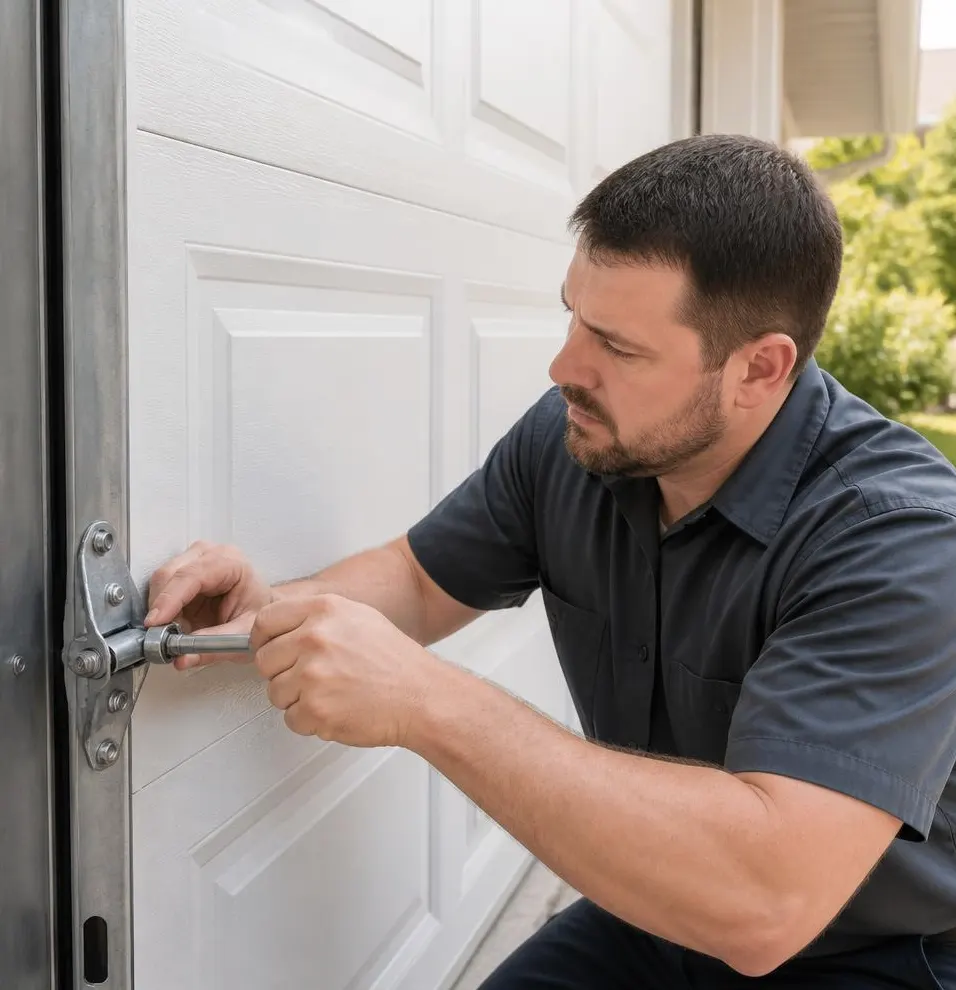
The Mistake: Judging Springs by Looks Alone
Most homeowners' first move, when they worry about their springs, is to walk into the garage and stare at the coils. They're looking for rust, a visible crack, maybe a gap that looks "off." If nothing jumps out, they relax and move on. It's an understandable instinct — the spring is right there, mounted above the door, easy to see and easy to assume you can judge by eye.
The problem is that spring failure is usually a fatigue problem, not a cosmetic one. A torsion or extension spring can look perfectly intact right up until the moment it lets go, because the metal is failing from the inside through thousands of cycles of winding and unwinding, not from surface damage you can spot in a five-second glance. Relying on a visual check alone is tempting because it's fast and feels thorough, but it misses almost everything that actually predicts a break.
Why a Visual-Only Check Isn't Enough
Granite Bay's climate doesn't do your springs any favors. Hot, dry inland summers followed by a wet winter mean the metal expands and contracts with temperature swings, dust and wildfire smoke settle into the coils and winding cones, and winter rain introduces moisture that speeds up corrosion in spots you can't easily see — inside the coil wraps, around the stationary cone, or where the spring meets the shaft. None of that shows up as an obvious red flag until the spring is already compromised. That's why a real check has to go beyond looking and into testing how the door actually behaves.
The Walk-Through Checklist
Before you start, disconnect the automatic opener by pulling the release cord so you're working with the door under manual control only, and never put your hands near a torsion spring itself. Everything below is about observation, not disassembly.
- The balance test. With the opener disconnected, lift the door about halfway and let go. A door with healthy springs will stay roughly in place. If it drops to the floor, the springs have lost tension and are no longer doing their job. If it shoots upward on its own, you may have one spring that's still strong compensating for one that's failed or weakening fast — an uneven, dangerous setup.
- The coil gap check (torsion springs). With the door fully closed, look at the torsion spring above the door. The coils should sit close together with even spacing. A stretched gap between coils, even without rust, means the metal has lost some of its wind tension and is fatiguing.
- The stretch and cable check (extension springs). On doors with extension springs running along the horizontal tracks, check whether the spring looks noticeably longer than its resting length, and inspect the safety cables that run through the center of each spring. Frayed, kinked, or missing safety cables mean that if the spring does snap, there's nothing to contain the broken ends from whipping loose.
- Listen to the opener. A healthy spring carries most of the door's weight, so the opener motor should sound consistent through the whole cycle. If you notice the motor straining, humming longer than usual, or laboring more on the way up than it used to, the spring is quietly handing more of the work over to the motor — a sign it's losing strength.
- Watch how the door travels. Open and close the door a few times and watch the motion itself. Jerking, hesitating partway, or one side appearing to lag behind the other points to springs wearing unevenly. Since two torsion springs or two extension springs rarely fail at exactly the same rate, this kind of lopsided movement is often the earliest visible clue.
- Check the winding cones and end brackets. The small cones at the ends of a torsion spring, and the brackets holding extension springs to the track, take a lot of stress. Look for hairline cracks, rust streaks, or a cone that looks like it's slipped slightly out of position. These parts fail independently of the spring itself but are just as likely to cause a sudden, dangerous release.
- Look for rust and pitting, not just surface dust. A light coat of dust from a dry summer is normal. What matters is pitting — small, rough divots in the metal where rust has actually eaten into the coil. Pitted spots are weak points where a break is most likely to start, and they're more common after a wet winter if the garage doesn't get much airflow.
- Count the cycles, roughly. Most residential springs are rated for somewhere in the range of 10,000 cycles (one cycle being a full open-and-close). If your door is original to a home that's ten or fifteen years old and gets used multiple times a day, the springs are likely well into their expected lifespan even if nothing looks wrong yet.
If any one of these checks comes back off, treat it as a timeline, not an emergency — except the balance test. A door that won't hold its position halfway up is telling you the springs are already past the point of safe daily use.
When to Call Granite Bay Garage Door Works
If your balance test fails, you spot coil gaps or pitting, or the opener has started straining, it's time for a professional look rather than a wait-and-see approach. Our Spring Replacement service includes testing both springs as a pair (even if only one shows wear, since the other is usually close behind), checking the cables, pulleys, and winding cones for related damage, and setting the new springs to the correct tension for your door's weight. If you're not sure whether what you're seeing is a spring issue or something else, our Garage Door Maintenance visits cover a full inspection of the springs, hardware, and opener so small problems get caught before they turn into a dead door on a Monday morning.
If you're in Granite Bay, Roseville, Rocklin, Folsom, Loomis, Lincoln, Auburn, or Orangevale and any of this checklist raised a flag, give Granite Bay Garage Door Works a call — we'll come take a real look before the springs decide the timing for you.